🚩 Tactical Memo 051: How to stop managing problems and start owning them

Justin Bateh
April 15, 2026
In partnership with

The IT strategy every team needs for 2026

2026 will redefine IT as a strategic driver of global growth. Automation, AI-driven support, unified platforms, and zero-trust security are becoming standard, especially for distributed teams. This toolkit helps IT and HR leaders assess readiness, define goals, and build a scalable, audit-ready IT strategy for the year ahead. Learn what’s changing and how to prepare.
Read time: 8 minutes
Welcome to Tactical Memo, my memos on helping leaders and teams execute and operate smarter in the AI era. Each issue tackles one real workplace challenge and hands you a ready-to-use solution.
If you want practical guidance you can use at work this week, you are in the right place.
👉 Why Read This Edition: You are going to learn the single behavioral difference between the people who get promoted and the people who get managed, and how to start operating on the right side of that line this week.
ON THE CALENDAR
Become Irreplaceable: How To Develop The 5 Senses AI Can't Replace
1 Day Workshop
When AI Gives Everyone the Same Tools, Execution Sense Is What's Left
https://maven.com/justinbateh/execution-sense?promoCode=newsletter
Session 1 is sold out. Sessions 2 and 3 are open.
Use the link above to save 15%.
How To 10x Your Productivity with Claude Cowork
1 Day Workshop
Your work is everywhere. We'll show you how to pull it all together.
https://maven.com/justinbateh/coworkworkshop?promoCode=newsletterclaude
Session 1 is sold out. Sessions 2 and 3 are open.
Use the link above to save 15%.
AI-Powered Project Management
4 weeks - Live Cohort
Build the skills to apply AI to your real projects, starting week one. maven.com/justinbateh/aiproj
Project Management That Actually Works
4 weeks - Live Cohort
Build the project management skills that actually drive outcomes. maven.com/justinbateh/proj
THE PROBLEM

I want to describe two people to you. You have worked with both of them. You might be one of them right now.
The first person is competent. They hit their deadlines. They respond to Slack within the hour. When a problem shows up, they document it, flag it to the right person, and wait for a decision. Their status reports are clean. Their task list is always current. On paper, they are doing everything right.
The second person is also competent. They also hit their deadlines. But when a problem shows up, they do something different. They do not just flag it. They walk into the room with two options, a recommendation, and a timeline for each. They did not wait to be asked. They did not wait for permission. They saw something broken and they moved toward it.
The first person is a manager. The second person is a leader. And the gap between them has nothing to do with title, seniority, or how many direct reports sit under their name on an org chart. The gap is one skill. One behavior. One reflex.
Agency.
The ability to see a problem and own it without being told to. The instinct to act when the easier path is to wait.
Most people spend their entire career on the wrong side of this line. Not because they are incapable. Because nobody ever told them the line existed.
Here is how it usually plays out. Someone early in their career learns that the safe move is to escalate. Flag it. Send the email. Put it in the risk register. Let someone above you decide. And that works for a while. It keeps you out of trouble. It protects you from blame. But it also trains you to treat every problem as someone else's responsibility. After five or ten years of that, you have a person who is technically excellent and operationally passive. They can run the process. They cannot run the room.
The other failure mode is the person who confuses activity with agency. They jump on every fire. They reply to every thread. They volunteer for every task force. But they never actually solve anything. They are busy, not effective. Movement without direction is not agency. It is chaos with good intentions.
Both types end up in the same place. Stuck. Wondering why the person who showed up two years after them just got promoted over them.
Here is the reframe. Agency is not a personality trait. It is not something you are born with or without. It is a behavior pattern. And behavior patterns can be trained, practiced, and built into how you operate every single day. The people who figure this out are the ones who stop waiting for their career to happen to them and start making it happen on their own terms.
THE SOLUTION: THE OWNERSHIP REFLEX
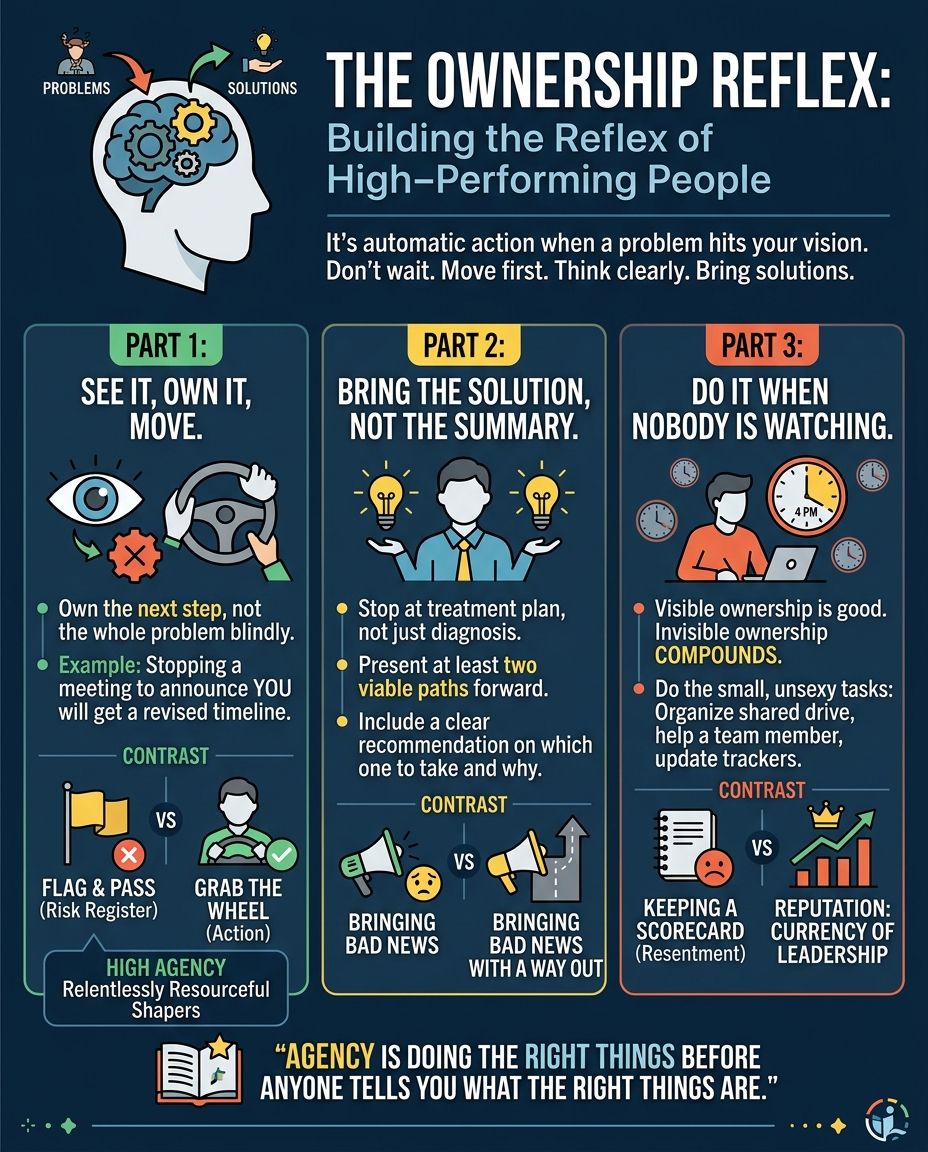
I have been on enough teams and inside enough organizations to see this pattern clearly. The highest-performing people I have ever worked with, on consulting engagements, on recovery teams, on cross-functional projects with no clear authority, all had the same reflex. They did not wait. They moved first, thought clearly, and brought solutions instead of observations. I started calling it the Ownership Reflex because that is exactly what it is. A reflex. Something that fires automatically when a problem hits your field of vision.
You can build this reflex. It has three parts.
Part 1: See it, own it, move
The first part is the simplest and the hardest. When you spot a problem, you do not pass it along. You own it. Not forever. Not blindly. But you own the next step.
Here is what that looks like. You are in a cross-functional meeting and someone mentions that the client data migration is behind by a week. Nobody says anything. The PM running the meeting moves on to the next agenda item. Everyone assumes someone else will deal with it.
The high-agency person stops the meeting. Not aggressively. Not dramatically. They say "I am going to pull the migration lead after this meeting and get a revised timeline by end of day tomorrow. I will send it to this group by Thursday." That took ten seconds. Nobody asked them to do it. Nobody assigned it. They just moved.
Here is what you do not do. You do not send a follow-up email that says "wanted to flag that the migration seems behind, can someone look into this?" That is a flag, not an action. Flags are what people plant when they want credit for noticing a problem without taking responsibility for fixing it. I have seen entire projects fail while the risk register was perfectly up to date. The register was not the problem. The lack of someone grabbing the wheel was the problem.
There is a concept that has been getting a lot of attention called high agency. Paul Graham described this type of person as relentlessly resourceful. Ray Dalio calls them shapers. The label does not matter. What matters is the behavior. You see the problem. You own the next move. You do it now, not after the meeting, not after lunch, not next sprint.
Part 2: Bring the solution, not the summary
This is where most competent professionals stall. They are good at identifying problems. They write clear escalation emails. They build thorough risk assessments. But they stop at diagnosis.
A doctor who tells you that you are sick and then sends you home is not practicing medicine. A PM who tells leadership the timeline is at risk and then waits for instructions is not leading. You have to bring the treatment plan.
Before you raise a problem to anyone, you should have at least two options ready. Not perfect options. Not fully baked strategies. But two paths forward with a clear recommendation on which one you would take and why. This changes everything about how people perceive you. You go from being the person who brings bad news to the person who brings bad news with a way out.
I worked with an operator once who was brilliant at this. Every time she walked into a room with a problem, she had already talked to the two people who could fix it, gotten their availability, and drafted a proposed path. Her manager told me he stopped worrying about anything on her plate because he knew if she was bringing it to him, she had already done the work. She needed a decision, not a direction. That is the difference.
Here is what you do not do. You do not walk into your skip-level or your steering committee and say "we have a problem" and then wait for them to solve it. That is not transparency. That is abdication. You are handing your credibility to the person who does come up with the answer, because now they look like the leader and you look like the messenger.
Part 3: Do it when nobody is watching
The first two parts are visible. They happen in meetings and in email threads and in conversations with leadership. This part is the one that compounds.
The highest-agency people I have worked with did not just perform ownership when there was an audience. They did it on a Tuesday afternoon when nobody was paying attention. They noticed the shared drive was a mess and spent 30 minutes organizing it. They saw that the new team member was struggling with the reporting tool and walked them through it without being asked. They updated the project tracker at 4pm on a Friday because they knew Monday's standup would go smoother if the data was clean.
None of those actions show up in a performance review. None of them are in anyone's OKRs. But they create something that no title or promotion can manufacture. They create a reputation. And reputation is the currency of leadership.
Peter Drucker wrote that management is doing things right and leadership is doing the right things. I would add one layer to that. Agency is doing the right things before anyone tells you what the right things are.
Here is what you do not do. You do not keep a mental scorecard of all the unrewarded work you are doing and then resent your team or your manager for not noticing. That is not agency. That is keeping score. The person who operates with genuine ownership does not need recognition to keep going. The work itself is the signal. And the right people always notice eventually. I have never seen a consistently high-agency person get overlooked for more than one cycle. The ones who get overlooked permanently are the ones who were performing agency, not practicing it.
THE REAL TEST

Here is the question. When was the last time you solved a problem at work that was not yours to solve?
Not a problem your manager assigned. Not a task on your sprint board. A problem you noticed, owned, and moved on because it was the right thing to do and nobody else was going to do it.
If you can answer that question with something from the last two weeks, you are operating with agency. If you have to think back months or struggle to find an example, that is your signal.
The people who build careers that compound are not the ones with the longest resumes or the most certifications. They are the ones who walk into a room and people instinctively trust that if something goes wrong, that person will handle it. That trust is not given. It is earned one unrequested action at a time.
Here is your action step for this week. Find one problem at work that is not technically yours. Something you have noticed but have been waiting for someone else to address. Take 15 minutes today to figure out two options for fixing it. Pick the better one. Send a message to the person who needs to know and tell them what you are going to do about it. Do not ask for permission. Inform and act.
That is agency. And once you start practicing it, you will not stop. Because the results speak louder than any framework ever could.
If this helped you, send it to someone who could use it this week.
Until next time,
Justin
✍️ From the Desk of Justin Bateh, PhD
Simple tactics. Real results. No fluff.
